

If you’re on a demand tariff, your most expensive 30 minutes can set the tone for the whole month.
Most businesses assume their electricity bill is mainly about kWh, how much energy you use. Sometimes that’s true, but for plenty of commercial sites the real pain sits somewhere else, demand.
I recently completed an energy audit for a hospitality venue with strong winter seasonality. After last season’s bills became a real pain point, they wanted to get ahead of it before the next busy period hit.

What are demand charges?
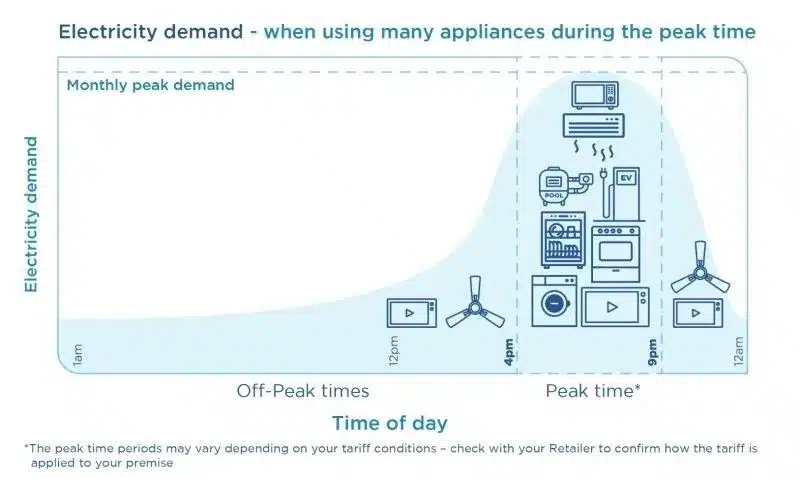
Demand is the rate your site draws electricity, basically how much power you are using at once. Many tariffs include demand charges that are set by your highest kW or kVA demand interval in a short block, often 30 minutes (sometimes 15 minutes), during a defined charging window. If that highest kW or kVA demand interval lands in the peak demand window (for example, weekdays 5 pm to 8 pm), the network applies a higher $/kVA rate, which can make that single interval very costly.
A simple way to picture it is this.
• kWh is distance (odometer), how far you travelled over the whole month
• kW or kVA is speed (speedometer), how hard you pushed at a point in time
• Peak demand is your top speed, the worst interval that gets “recorded” for billing
What was setting the peak?
The hospitality and resort venue’s peak was being created when multiple loads overlapped at the same time, for example:
• Kitchen equipment ramping up for dinner service (combi oven, dishwasher cycling)
• HVAC recovering, split systems pulling hard right as service starts
• Outdoor radiant heaters switching on together on cold evenings
• Refrigeration compressors cycling in the background (cold room, freezer, bar fridges)
• Hot water boost kicking in at the wrong time
None of these loads were “wrong”, the issue was timing. A few normal things, happening together, in the same window, over and over.
Why this matters
You can work hard on efficiency and still get hit with big bills if your demand peak keeps getting set in the same part of the day. That’s why demand is so frustrating, it’s not always about using lots of energy, it’s about when it’s used.
What we focused on
Once the drivers were clear, I worked with the site staff to map out what was happening operationally, then we built a practical plan to smooth the ramp-up without disrupting service.
The priority actions were:
- Staggering warm-up and ramp-up loads (not everything at once)
- Smoothing HVAC recovery (earlier pre-heat, less aggressive setpoint changes)
- Shifting flexible loads away from the spike window
- Adding demand guardrails (alerts, simple procedures, basic limits where appropriate)
Savings without sacrifice
It’s important to remember that businesses need to run to meet customer expectations and operational requirements. Demand reduction should never come at the expense of comfort, operational workflows, safety, or service levels.
The goal is not “turn it off”, it’s “run it smarter”.
Why I enjoy this part of the job
These projects are rewarding because they are often low to no cost measures that can have a big impact. In this case, we identified peak demand savings opportunities of approximately 35% per year, largely through better sequencing and a few control improvements.
It is also a realistic pathway for businesses that do not have a big budget for upgrades. Batteries and HVAC replacements can be great, but they are not always feasible to implement straight away. Operational demand management can reduce costs now and buy time to plan bigger upgrades properly when the time is right.
This sound familiar?
If your site has seasonal peaks, if your bills feel out of proportion to what you think you’re using, or if you’re on a demand tariff and have never really looked at what happens inside those charging windows, it’s worth investigating.
A Type 1 energy audit is often enough to identify the spike, link it to what’s happening onsite, and build a practical plan that doesn’t disrupt how the business runs.